A map of meaning
Have you ever typed a vague search into Google, the keywords all wrong, and it still understood and gave you exactly what you needed?
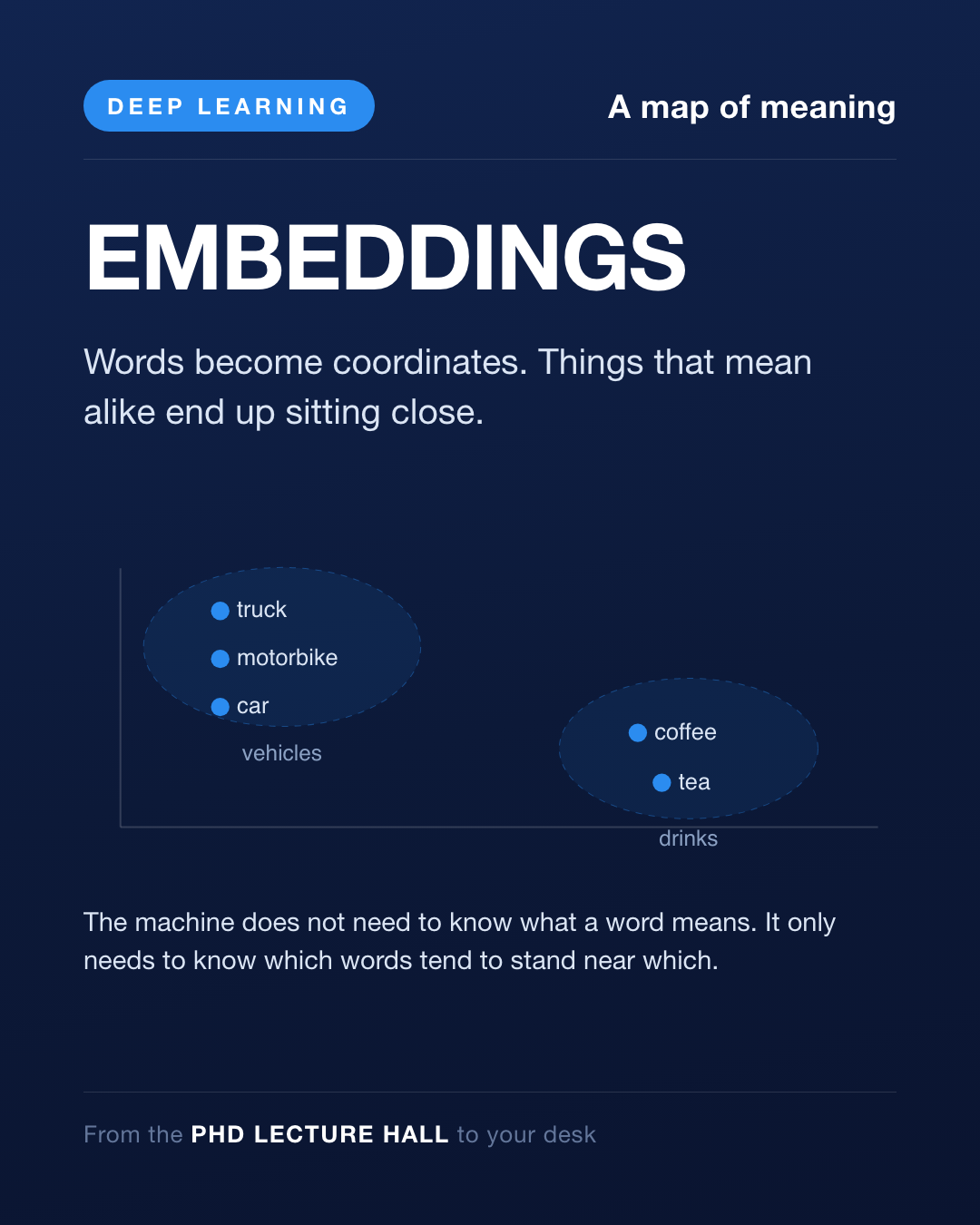
Have you ever typed something vague into Google, the keywords all wrong, and it still understood and returned exactly what you needed? Behind that moment of “it got what I meant” sits one of the most foundational ideas in AI today. The name sounds technical: embeddings. The substance is easy to picture.
Computers do not read words the way people do. For them, everything must come down to numbers in the end. So how does something as abstract as “the meaning of a word” become a number? The method, put simply, is to place every word on an enormous map. On that map, words with close meanings sit close together: “coffee” next to “tea”, while “car” sits off in another region entirely. Each word's position on the map is a string of numbers. And so “meaning” becomes something measurable: the closer two words sit, the more alike their meanings.
What is striking is that once the machine has learned this map, it holds relationships nobody taught it directly. A famous 2013 experiment at Google, the word2vec model trained on around 100 billion words of news text, showed this: take the position of “king”, subtract the “man” part, add the “woman” part, and you land on “queen”. The machine was never taught that; it drew it out of how words tend to appear beside each other.
Why should this matter to anyone in business? Because it is exactly why a good system understands you even when you do not use the right word. It compares meaning rather than spelling. And that mirrors something very human: customers rarely say the exact “keyword” in their heads; the value lies in hearing the real meaning behind the words.
This past week, how often did your team hear exactly what a customer said and miss what they actually needed?
To your desk
The machine learned that words close in meaning sit close together: it arranges by sense rather than by spelling. The way we arrange information in an organisation is usually the opposite: by name, by department, by date.
A small experiment for this week: pick a question customers keep repeating, then recall how many different wordings the same idea has arrived in. If each wording ends up filed somewhere separate, we are probably storing by word and not by meaning, and quietly missing a need that keeps coming back.
Understanding the meaning, in the end, matters more than matching the word.