Adjusting the pattern, not redrawing it
This is a fine example of how being cleverer sometimes means doing less, in the right place.
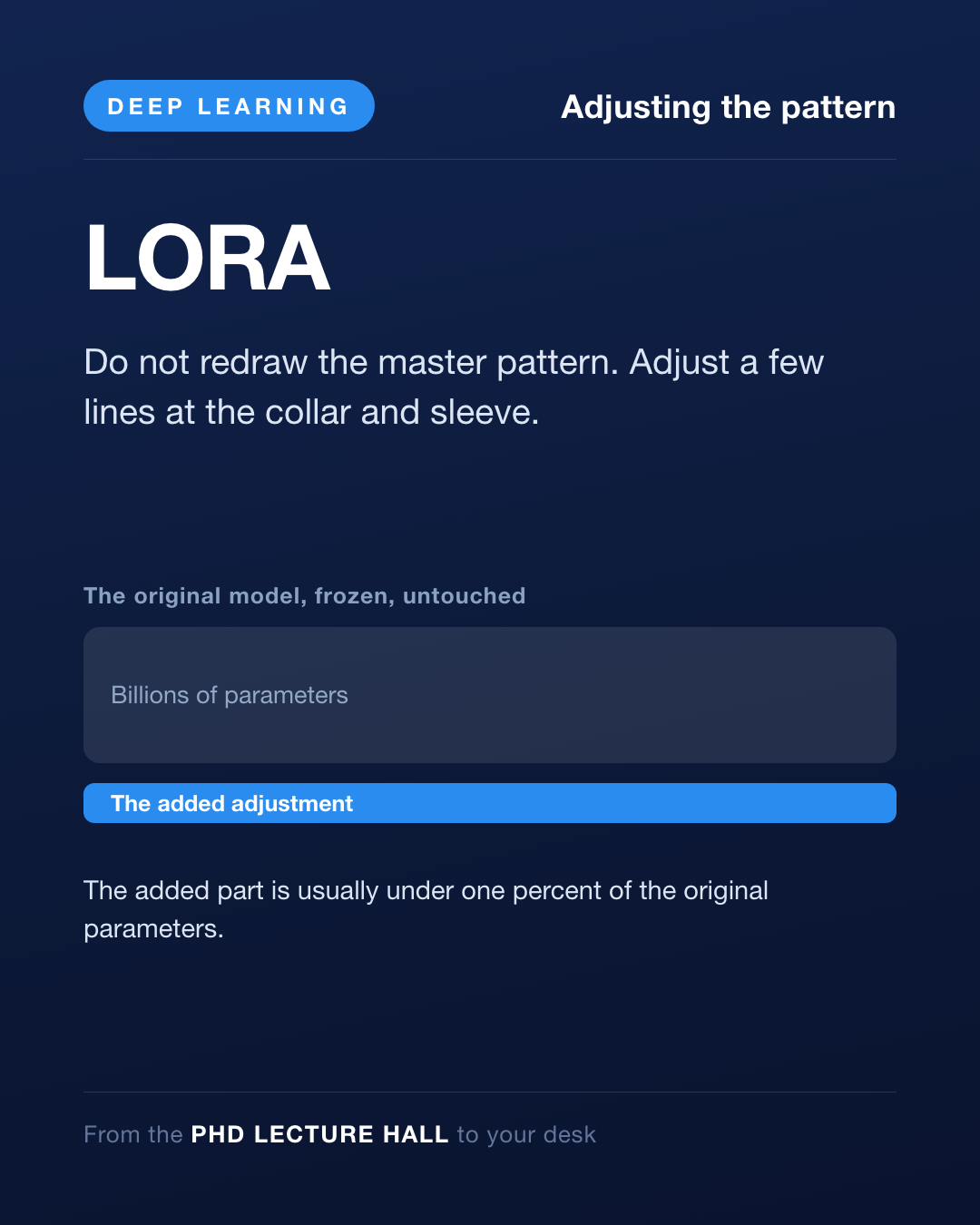
This is a fine example of how "being cleverer" sometimes means "doing less, in the right place".
What parameter-efficient fine-tuning is
Picture a friend's tailoring workshop. Whenever a customer orders a new cut, she does not redraw the whole master pattern she spent years perfecting, she adjusts a few lines at the collar and the sleeve. The master pattern stays as it is, the adjustment is small and tidy, and that same pattern serves a great many different orders.
LoRA, low-rank adaptation, does exactly that to an AI model. Instead of retraining all hundreds of billions of parameters, it freezes the original model and trains only a few small matrices inserted alongside. This is a form of parameter-efficient fine-tuning, shortened to PEFT. The original paper by Hu and colleagues in 2021 reported that LoRA cut the number of trainable parameters by roughly 10,000 times and GPU memory by about 3 times on GPT-3 with its 175 billion parameters, while quality stayed level with full training.
How this applies to running a business
I like to think of this as a lesson about the real cost of improvement. Wanting to change something does not always mean tearing it down and rebuilding. There is usually a small point, in exactly the right place, that produces a large difference at low cost.
The same holds in operations: before replacing a whole process, look for your own few adjusted lines, the small, low-cost intervention with a clear effect. Keeping the core stable and tuning only where it is needed is how progress holds without breaking.
In your business, where is the small, low-cost place that, adjusted correctly, would change the whole result?