A kitchen full of agents
This is the direction that made me think hardest about how a lean team ought to be organised.
This is the direction that made me think hardest about how a lean team ought to be organised.
What multi-agent systems are
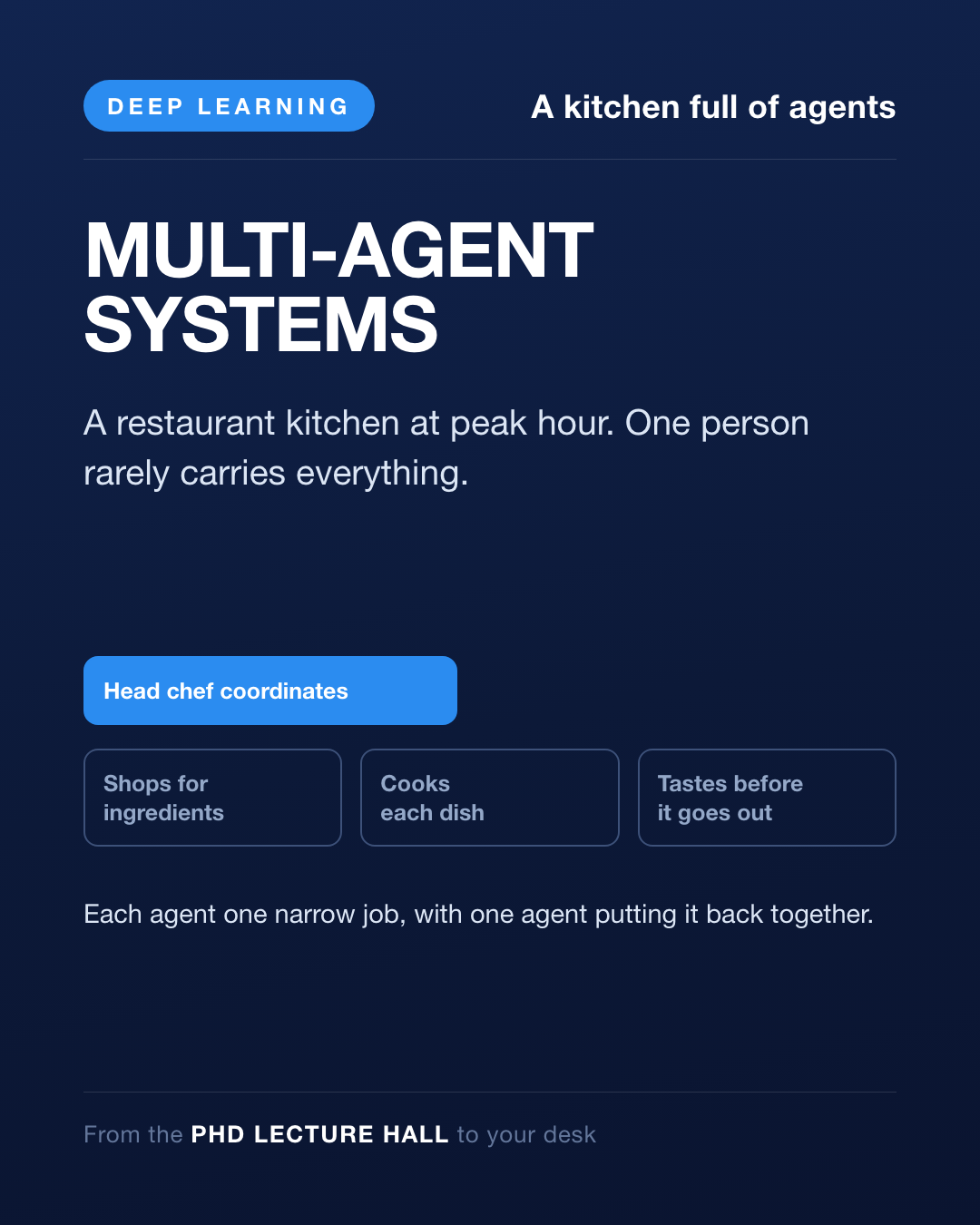
Picture a restaurant kitchen. It is not one chef doing everything, but someone prepping, someone on the hot station, someone checking each dish before it goes out, and a head chef coordinating. Each holds a role and they coordinate through a few short exchanges. Multi-agent systems in AI work the same way: instead of one model carrying the whole process, several specialised AI agents coordinate, each with a role, with one agent coordinating.
A well-known study is Generative Agents by Park and colleagues in 2023, presented at the UIST conference, which simulated 25 AI agents living in a virtual town called Smallville, each with its own memory and daily schedule and able to interact with the others, producing coordinated behaviour nobody had programmed in advance.
How this applies to running a business
I find the lesson closer to managing people than one might expect. A strong system is rarely one superhuman doing everything, but a team with clear roles and coherent coordination. The same holds when handing work to AI: splitting a large task into specialised steps, each with its own agent, usually gives a better and more checkable result than making one model do it all at once.
But dividing roles only works when someone coordinates and the flow is clear. Many capable agents without a conductor produce only chaos, whether they are AI or people.
If you pictured an overloaded task in your team as a kitchen, what roles would you split it into, and who is the head chef?