A proof of concept with a deadline
A trial with no stopping point becomes a quiet expense. Give every AI trial a time limit and a measure from the very start.
There is a sentence I hear again and again in meetings: "We are piloting that one." It sounds reassuring, but ask a little further and it turns out the pilot has been running for nearly a year, has cost a fair amount, and nobody can say whether it works or not. A trial with no stopping point is no longer a trial. It becomes a quiet expense that simply goes on.
What a time-bounded proof of concept is
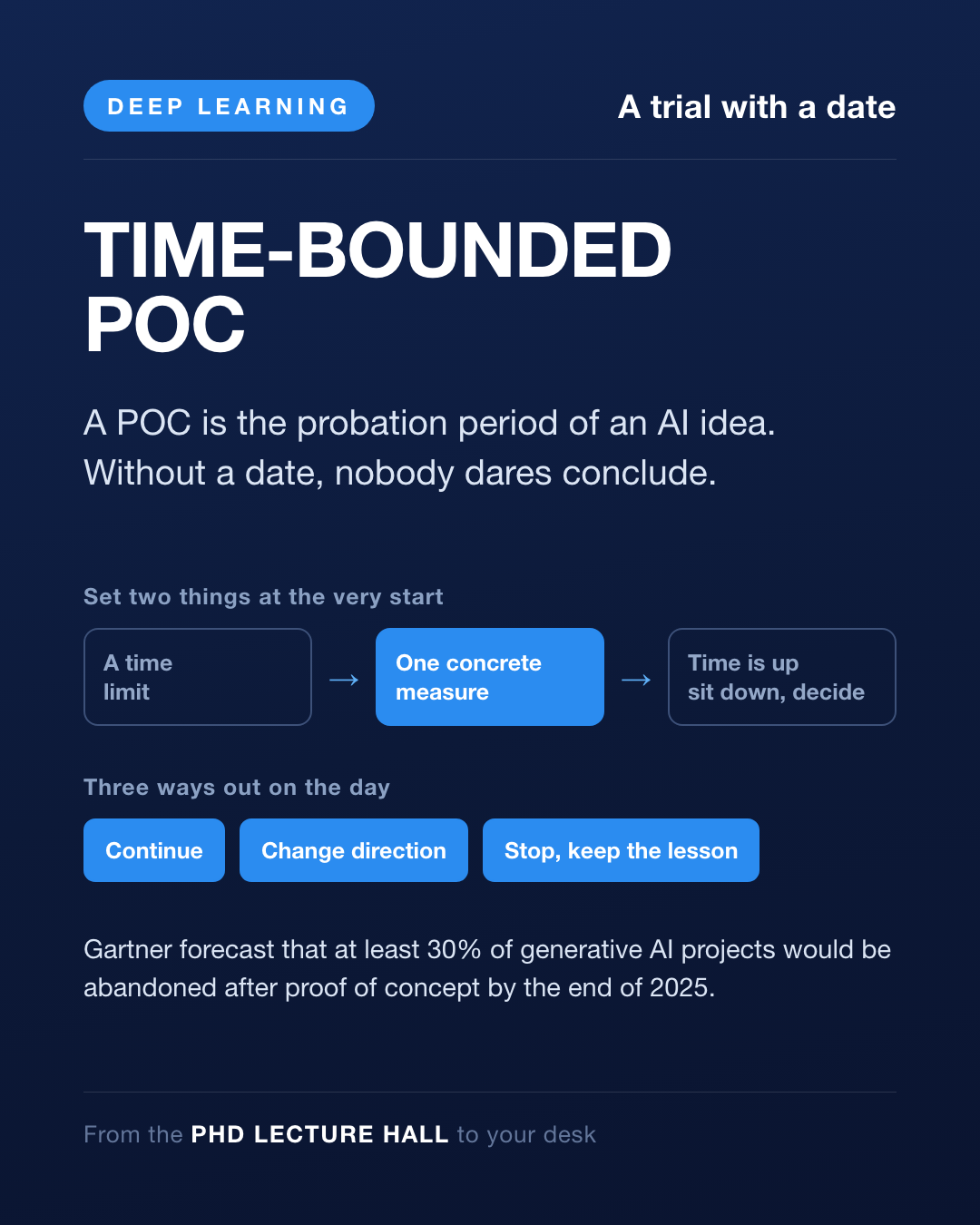
A proof of concept, POC for short, is a small trial built to answer exactly one question: is this idea feasible. Time-bounded means that from the start we give it two things: a time limit, say six weeks, and a concrete measure, say bringing order processing time from three days down to one. When the time is up we stop and look at the number to decide: continue, change direction, or drop it.
I often compare it to a probation period. When I take on someone new, I do not sign a lifetime contract on the first day. I give two months of probation, state the expectations clearly, and when the agreed day comes we sit down and review. A POC is the probation period of an AI idea. Without that agreed day, both sides keep hesitating and nobody dares to conclude.
One figure startled me: Gartner forecast that at least 30% of generative AI projects would be abandoned after the proof of concept stage by the end of 2025, because of poor data, escalating costs, or unclear business value. What is worth noting is that most of those projects could have stopped far earlier, had there been a time limit and a measure from the beginning.
How this applies to running a business
For someone running a business, a deadline is there to protect resources, not to stifle creativity. A healthy POC usually fits in one sentence: "Within six weeks, if the measure reaches the agreed threshold we go on; if not, we stop and take the lesson." Take a shop that wants to try an AI assistant answering customer messages: set a limit of one month, with the measure being that it fully answers 60% of frequently asked questions while customers stay satisfied. At the end of the month, decide by looking at that, instead of letting it limp along with nobody sure whether it is alive or dead.
The greatest benefit of setting a deadline is that it lets us stop without it feeling like failure. A POC that ends with "not there yet, so we will not scale it" is still a good result: we have answered the feasibility question for a small fraction of the cost, instead of feeding a project indefinitely just because we regret the effort already spent.
If you look back at the things your team is "piloting", how many truly have a date on which you will sit down and decide?