Choosing the right kind of tool
Many jobs that seem to need a large language model need only a few lines of rules. Choose the right kind of tool before discussing which tool.
Last week a business owner told me his team was planning to build a brand-new AI assistant to label orders automatically by delivery region. I asked: the order already states the province, so would a lookup table saying "this province belongs to this region" be enough? He laughed. A job that seemed to need a large language model turned out to need only a few lines of rules.
That small story touches a decision I see many organisations skip: choosing the right kind of tool for the problem, before discussing any specific tool.
What choosing the right kind of tool is
Picture a craftsman opening the toolbox. Some jobs need only a screwdriver, some call for a drill, and some do require bringing out the cutting machine. A good craftsman is not the one who always reaches for the strongest machine, but the one who knows which job deserves which tool.
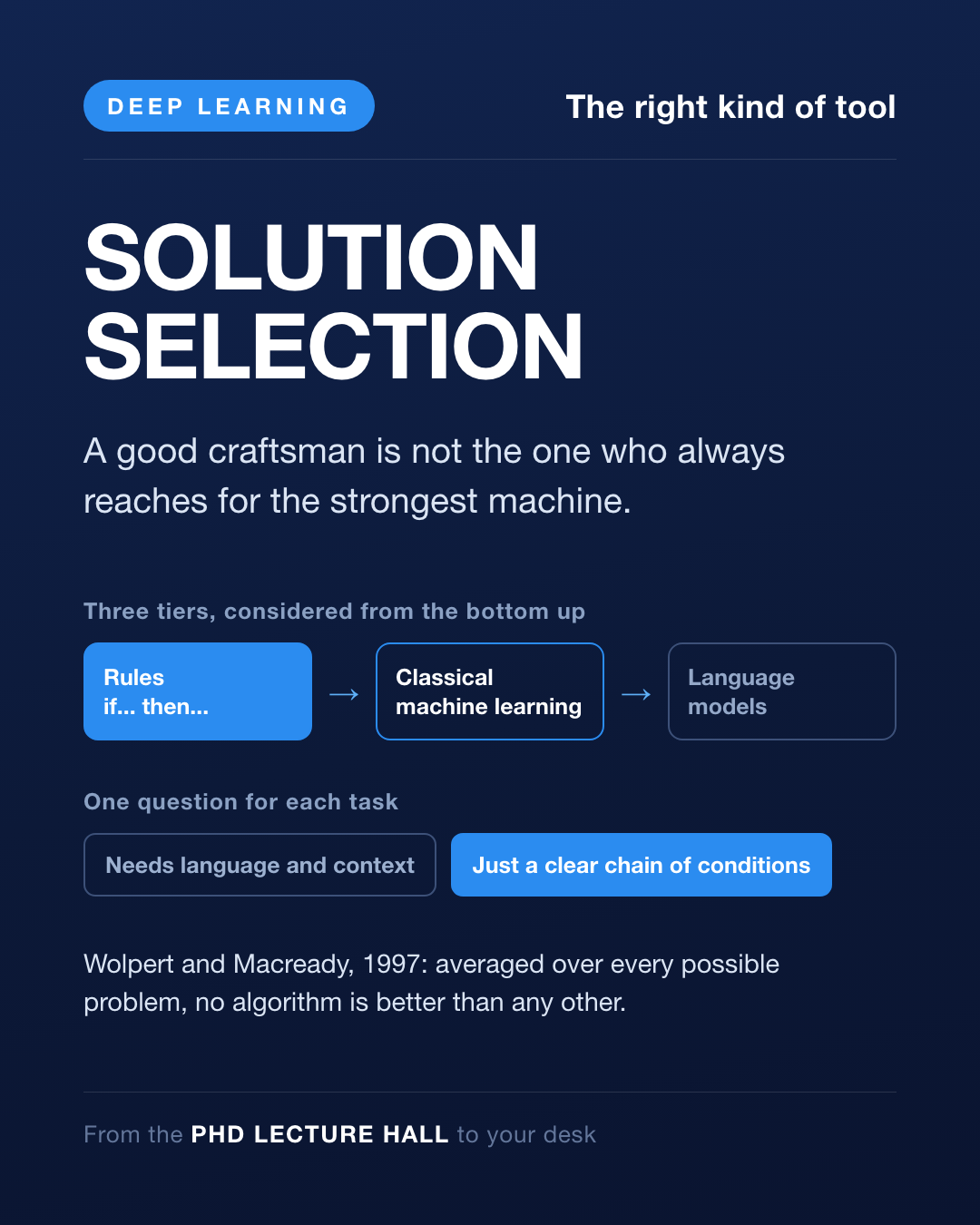
In AI, solution selection is the step of weighing the options tier by tier. The lowest tier is a rules engine: "if... then..." statements written by people, cheap, fast, and above all predictable in what they will do. The middle tier is classical machine learning, suited to cases with plenty of data where the pattern is hard to write by hand. Only the top tier is language models, small or large, for work that really needs an understanding of language and context.
In 1997 two researchers, David Wolpert and William Macready, proved something people in AI often cite: the No Free Lunch theorem. Put briefly, averaged over every possible problem, no algorithm is better than any other. What decides the outcome is whether the tool fits the problem in front of you, not how powerful it is.
How this applies to running a business
For someone running a business, that ladder is a discipline about cost and peace of mind. A large model answers very well, but every answer costs money, and sometimes the model answers in a way we did not foresee. A set of rules is the opposite: dull, but run it any number of times and it gives the same result, and when it is wrong you know at once which line is wrong.
I often suggest listing the jobs you are planning to hand to AI, then asking each one a single question: does this job really need an understanding of language and context, or is it just a clear chain of conditions? Most fall into the second group. Keep those for rules and spreadsheets, and save the large-model budget for the few jobs that truly deserve it. That is how a lean team still goes far.
In the list of jobs you want to automate with AI, how many in fact need only a simple set of rules?