Prioritising by pain and gain
Nobody can do twenty jobs that AI should take on. Place them on two axes, pain and gain, to see which is worth doing first.
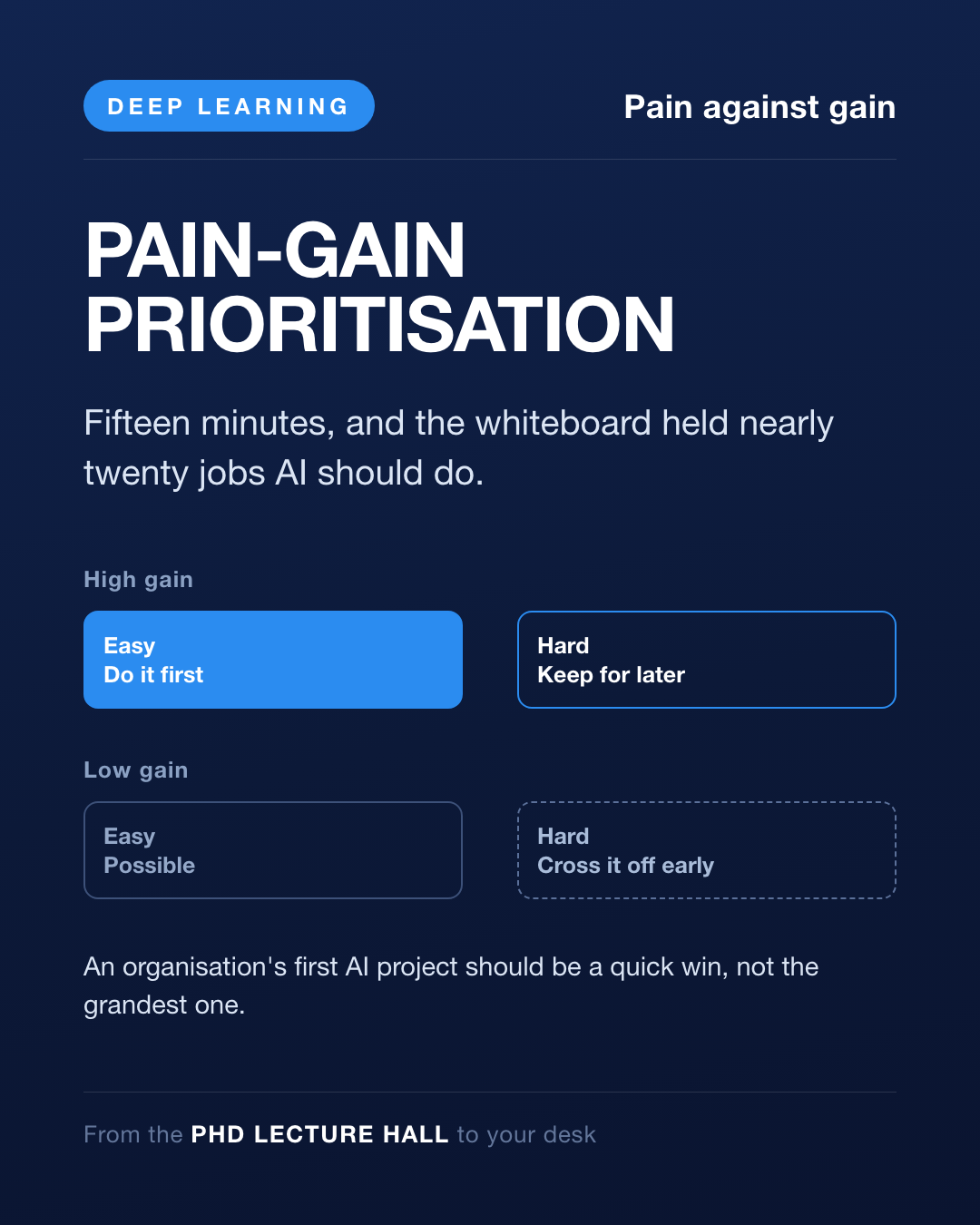
There is one meeting I will not forget. The team had just finished learning a few AI tools, everyone was excited, and within fifteen minutes the whiteboard held nearly twenty jobs that "AI should do". A customer care chatbot, contract summaries, stock forecasting, scoring candidate files. Every one of them sounded reasonable. The only trouble was that nobody can do twenty things at once, and when a team tries to hold them all, usually none gets properly finished.
What prioritising by pain and gain is
Picture yourself about to put a whole house in order after many years. Some jobs are easy and change the feel of the place entirely, like rearranging the chairs and throwing the windows open. Some are well worth it but swallow a whole week, like knocking two rooms into one. A sensible person starts with the easy jobs that make a visible difference, to gain the strength and the confidence to carry on with the heavy part.
Pain-gain prioritisation puts every job on a map in the same way, with two axes. One axis is gain, meaning how much value the job brings once it is done. The other is pain, meaning how much effort, cost and risk it takes. Four corners appear, and the corner worth putting your hands to first is where gain is high and pain is low, usually called a quick win.
This way of thinking is not new. In quality management, Lockheed Martin developed a tool called the PICK chart to sort improvement ideas onto exactly those two axes, with four boxes: Possible, Implement, Challenge and Kill. The Implement box, high gain and easy to do, is treated as the golden opportunities to take first. A very plain frame, yet enough for a team to stop arguing from feeling and look in the same direction.
How this applies to running a business
What I have learned is that an organisation's first AI project should be a quick win, rather than the grandest project. A small job that is really causing pain and whose benefit is clear, such as summarising hundreds of support emails each day for the customer care team. Once that is done, the team has more confidence, leadership has evidence for releasing more budget, and the people wary of technology begin to see AI standing on their side.
Projects that are both high gain and very hard are not dropped. They go into the challenge box, kept for when the team has enough capability and enough trust. As for jobs that cost a great deal and return very little, having the courage to cross them off early is a good decision too, because it gives time back to the work that is worth more. The map does not decide for the person in charge. It only helps the whole team see the price and the return of each choice before committing effort.
If you had to choose exactly one job to hand to AI first this quarter, which corner of that map would you place it in?