The value hypothesis
An AI project should begin with one sentence stating what will change, by how much and within how long, and that sentence must be one that can be proven wrong.
There is a sentence I hear every time a team starts thinking about AI: "Let us just try it and see what AI can do for us." It sounds open-minded, but three months later, when someone asks what the project has changed, the room usually goes quiet for a beat. The model is not performing badly. It is only that nobody said at the start what "do for us" meant: do what, for whom, and measured with which ruler.
What a value hypothesis is
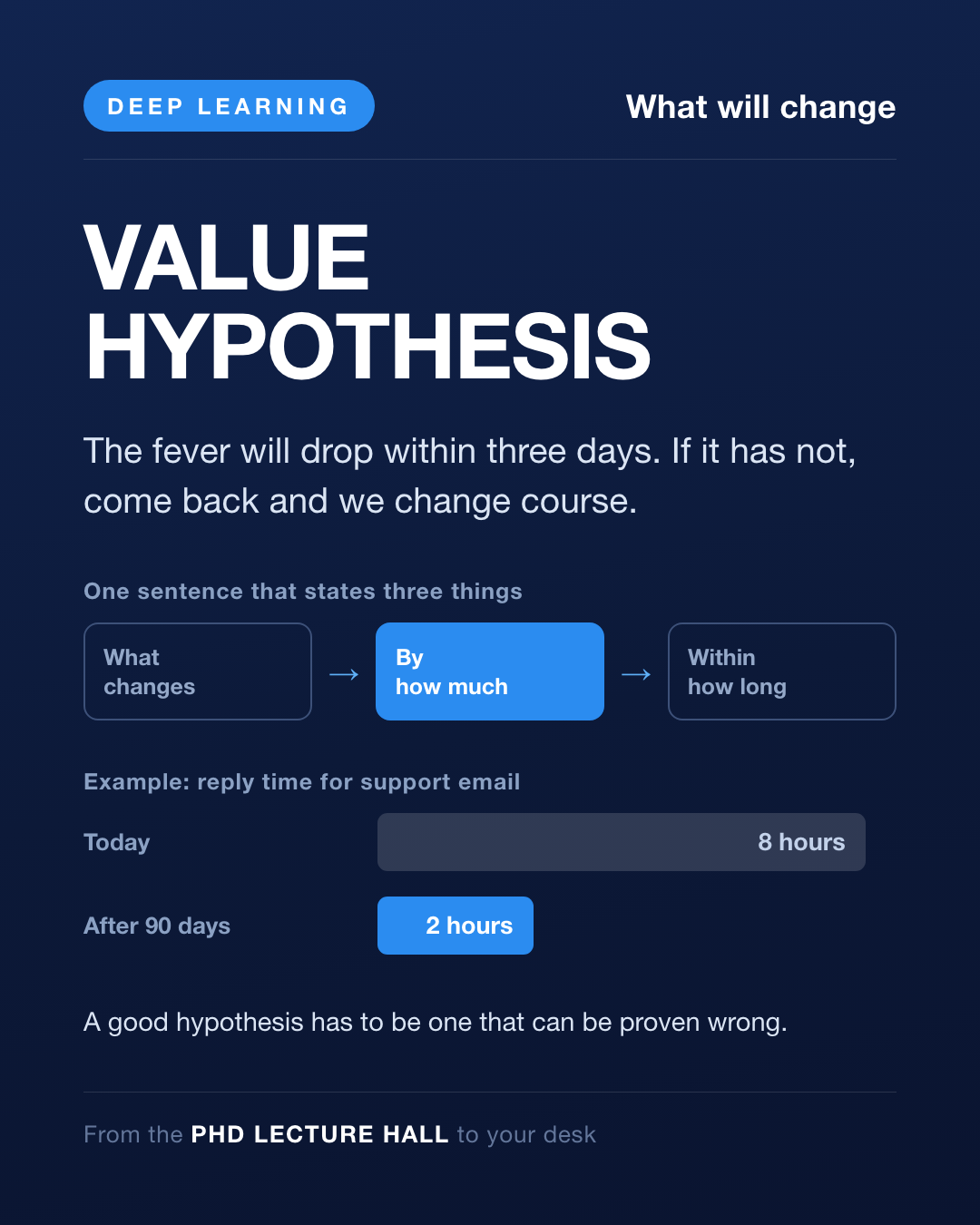
Picture a doctor who prescribes without saying what the medicine will do. A good one is different: "The fever will drop within three days. If it has not after three days, come back and we change course." That sentence is valuable because it can be wrong, and the error shows up very quickly.
A value hypothesis in an AI project carries the same spirit. It is one sentence that states three things: what this work will change, by how much, and within how long. The concept was brought into The Lean Startup by Eric Ries, published in 2011, where he defines it as the test of whether a product really delivers value to users once they start using it, rather than merely assuming it does. The heart of it is that a good hypothesis must be one that can be proven wrong, not a general good wish that everyone nods along to.
How this applies to running a business
The gap between the two ways of framing the question is very wide. "Use AI to answer customers faster" sounds reasonable but cannot be checked. Whereas "bring support email response time from an average of eight hours down to under two hours, within ninety days, without the share of customers who have to ask a second time going up" is a sentence we can sit down with and conclude true or false.
Being able to write a sentence like that forces the team to have three things before spending the first unit of budget. A baseline figure, to know where we stand. A destination, to know what counts as enough. And a time marker, so the project does not stretch on indefinitely in a state of being tried. The missing baseline is the most common fault: with no starting point, even if results truly improve, nobody can show that the improvement came from AI.
So a value hypothesis is not paperwork. It is how someone running a business turns AI from an open-ended game that easily drifts into a piece of work that can be declared a success or stopped with dignity. Stating clearly what will change is also a way of respecting the team's effort: they know where they are heading, and they know when it will be recognised.
If you had to write one value hypothesis sentence now for the AI project you are weighing, do you already have the baseline figure to fill in the blank, or is that the very thing to do first?