Fine-tuning or prompting
This is the question I am asked most when a business starts using AI: do we need to retrain a model of our own? In most cases, the answer is not yet.
This is the question I am asked most often when a business starts using AI: "Do we need to retrain a model of our own?" In most cases, the answer is not yet.
How fine-tuning and prompting differ
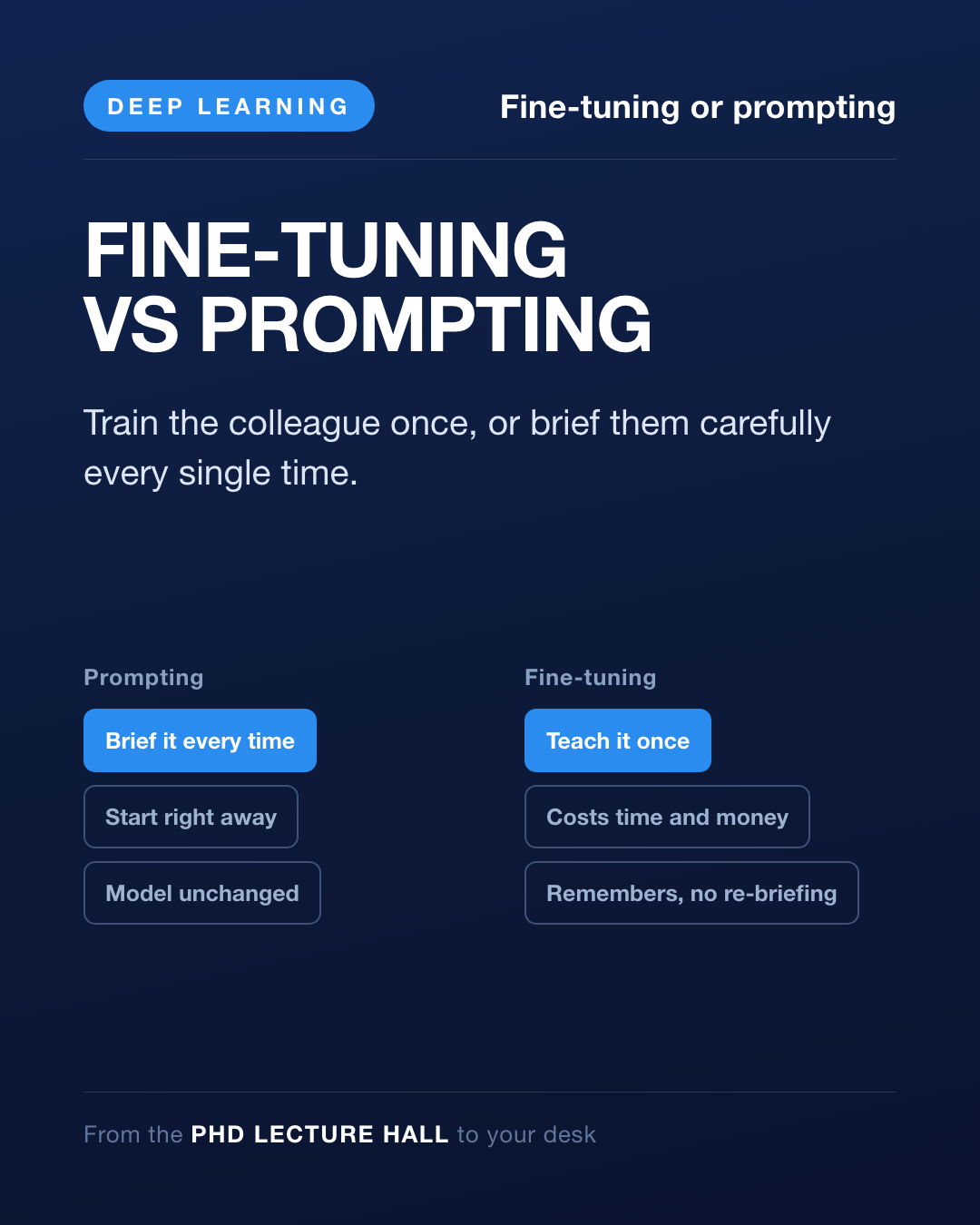
Picture having just hired someone very capable and experienced. There are two ways to get work that matches what you had in mind. The first is to set the task clearly: give the context, provide worked examples, say what format you want. That is prompting, a way of setting the brief well without touching their underlying ability. The second is to put them through an in-depth course using the company's own material, so your way of working sinks in. That is fine-tuning, retraining the model on your own set of examples.
Fine-tuning is powerful, but it costs effort and data. OpenAI's guidance recommends a minimum of around 10 examples before fine-tuning is worth starting, and clear improvement usually needs 50 to 100 good ones. Meanwhile a great many tasks are already met by one properly written brief.
How this applies to running a business
I see many teams jump to the idea of training their own AI when most of their problem is not yet knowing how to set a task clearly. It is the same as managing people: before complaining that someone is falling short, look at whether the brief you gave was clear enough.
The pragmatic rule is to start with the cheap and fast option. Write a good brief first. Only when a task repeats with very particular requirements, and no amount of careful briefing reaches it, is it time to consider fine-tuning. That order saves both time and budget without giving up quality.
Which task is your team handing to AI with results you are not happy with, and is it a problem with the brief or genuinely a case for retraining?
To your desk
Before reaching for a separate and expensive AI tool, most everyday needs can be met with a brief that is simply clear enough.
This week, try picking one task you often hand to AI where the result keeps missing the mark: writing emails, summarising, drafting replies to customers. Instead of getting annoyed and redoing it yourself, write it a fixed brief covering the context of the work, the tone you want, and two or three examples you consider right. Save it and reuse it.
It is the same way we hand work to a new colleague: being clear at the start is usually far cheaper than correcting it repeatedly afterwards.