How a machine learns to read
Think back to how a child learns to recognise digits. Nobody reads them a definition. They look, guess, get it wrong, get corrected, and gradually know.
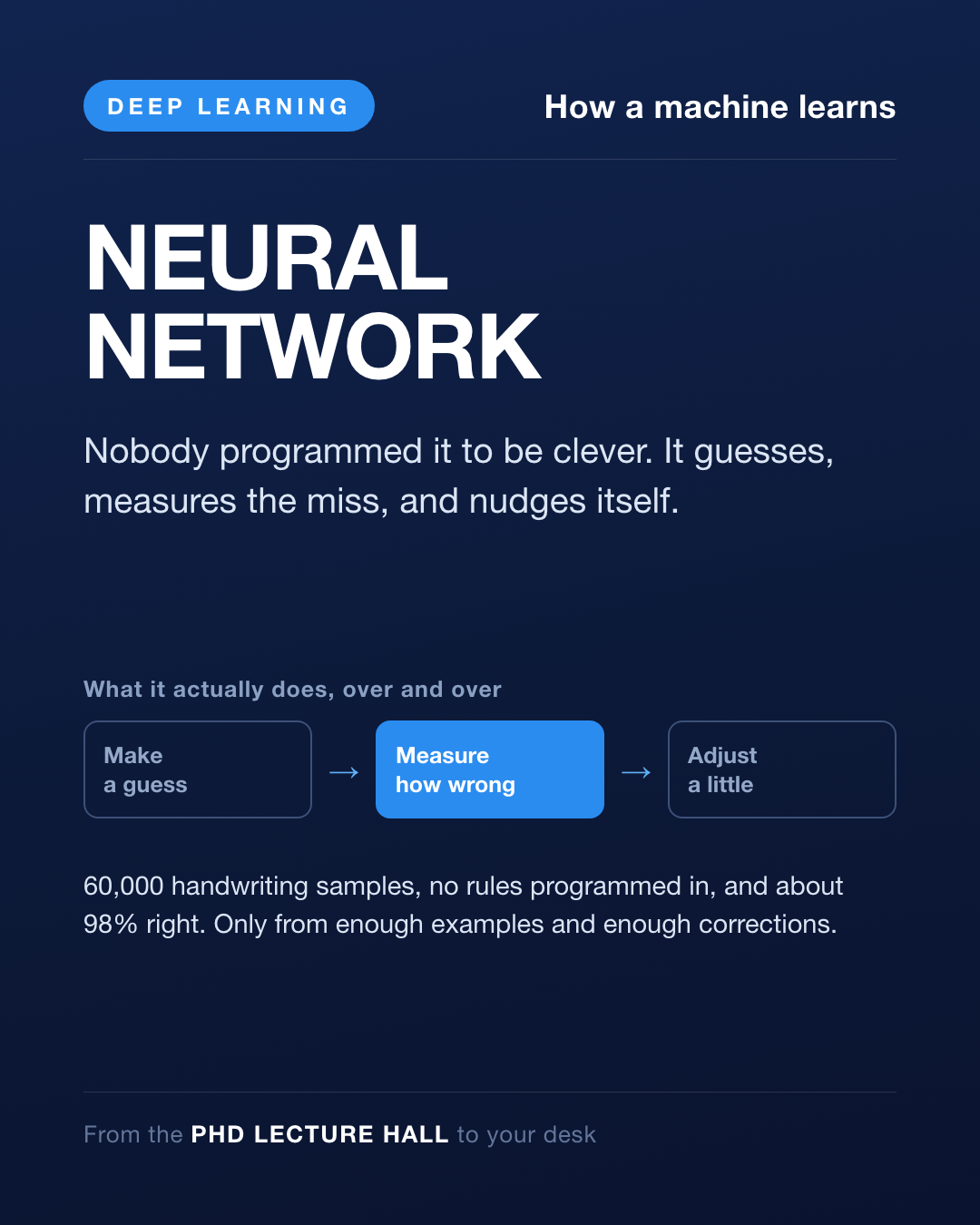
Think back to how a child learns to recognise digits. Nobody reads them the definition “the numeral 8 consists of two closed loops”. They simply look again and again, guess, guess wrong, get corrected, and gradually come to know. What surprised me when I began my research programme is that computers learn in almost exactly that way. Building machines along those lines is called a neural network.
We tend to think of computers as “intelligent”. What they are actually good at is this: make a guess, measure how wrong it was, then adjust itself a little so the next guess is less wrong. That is all, and repeated tens of thousands of times it becomes very good indeed.
The field's first exercise is teaching a machine to read handwritten digits. No rules are programmed in; the machine is simply given around 60,000 handwriting samples and left to work out the pattern after each wrong guess. The result is about 98% accuracy, purely from seeing enough examples and being corrected enough times.
The more I think about it, the more a mature organisation seems to follow the same path. We tend to expect that one well-polished training session will make the team better. But real capability grows the way that child's did: by running into specific situations and getting feedback each time something falls short. Without real examples and without feedback, theory struggles to become skill.
So the question I want to look at today is this: each week, how many real situations does your team actually get to grapple with, rather than sitting and listening to theory?
To your desk
The machine needed 60,000 examples to learn to read digits. Our teams rarely have that many, which makes choosing the examples all the more important.
A gentle approach for this week: pick exactly one skill you want the team to improve, say how to talk to a customer who is upset, and instead of lecturing, gather ten situations that actually happened and work through two of them together each week.
People improve the same way machines learn: from real examples, and from steady feedback.