Learning from the error
It sounds backwards, and it is the heart of how AI learns: what makes it better is not the times it guessed right, but the times it guessed wrong.
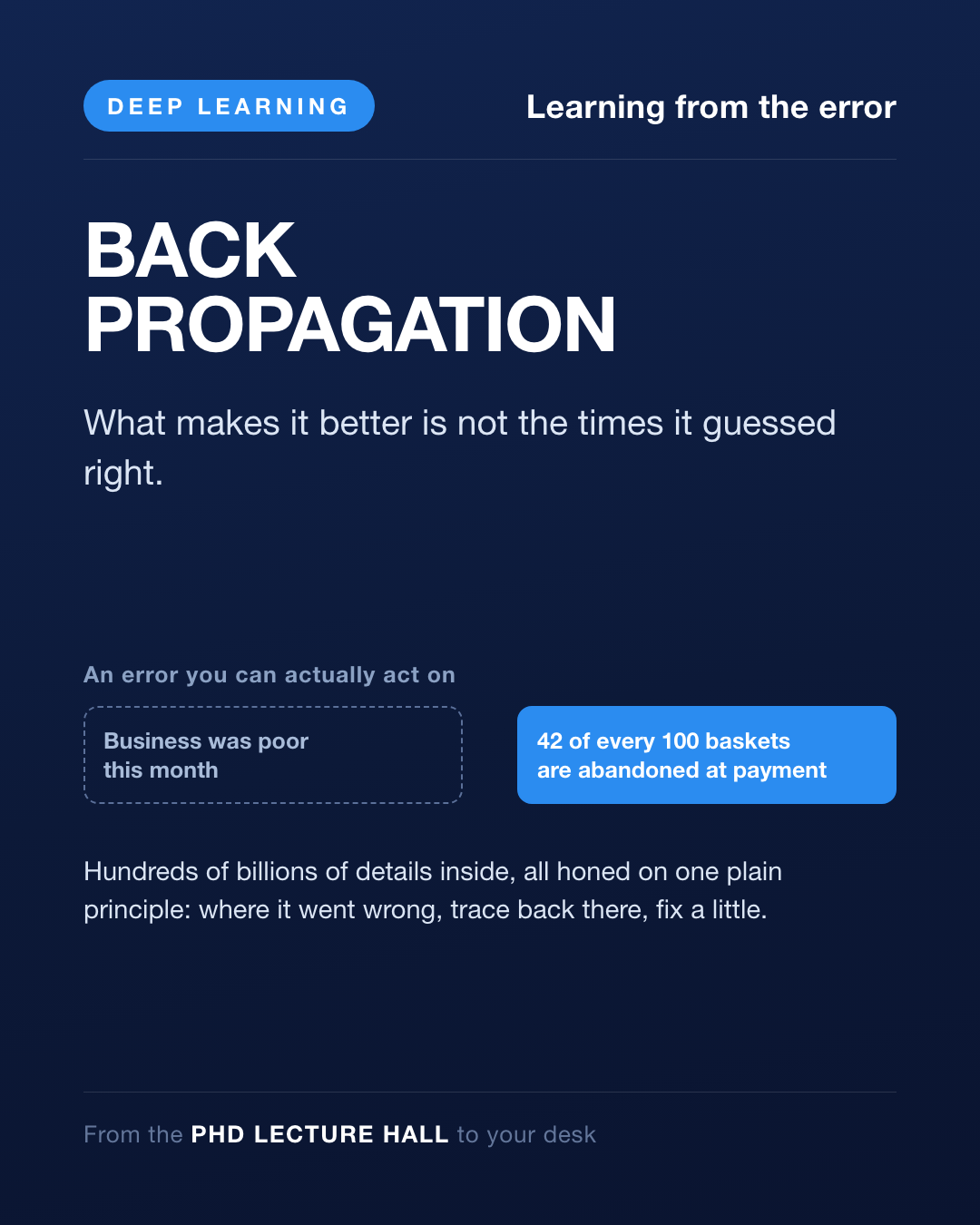
Here is something that sounds backwards and is nonetheless the heart of how AI learns: what makes it better is not the times it guessed right, but precisely the times it guessed wrong.
In the field this mechanism has a rather long name, backpropagation, but the idea is simple. Picture a student whose work has been marked. They look at where the marks were lost, trace back to find which step they misunderstood, and adjust their thinking for the next piece. The machine does exactly that: it makes a prediction, measures how far it sits from the answer, then traces back and nudges each internal detail a little in the direction that makes the error smaller. A large model like GPT holds hundreds of billions of such details, and all of them are honed on the same plain principle: where it went wrong, trace back there, fix a little.
What I often see is organisations doing the reverse. Instead of correcting steadily, they wait until the end of the quarter and then reorganise in one large push. Durable progress, though, usually comes from naming the error very specifically and adjusting small points week by week.
And to fix it, the error has to be clear enough. Saying “business was poor this month” gives almost nothing to work with. Saying “out of every 100 customers who reach the basket, 42 leave at the payment step” gives a very specific place to start.
The clearest error of your past week: could you name it with a number?
To your desk
A model improves by answering two very plain questions: how wrong was I, and where did it come from.
At the end of the week, we can borrow exactly that way of thinking. Pick one result that fell short, then calmly trace back three steps: where the result went off, which decision it started from, and what information was missing at that moment.
The purpose is not to assign blame but to find the right place to adjust. A system matures this way, and so do people.