Knowing what to ignore
What decides whether a cell in a neural network should speak up or stay quiet? The answer says a good deal about how we decide things.
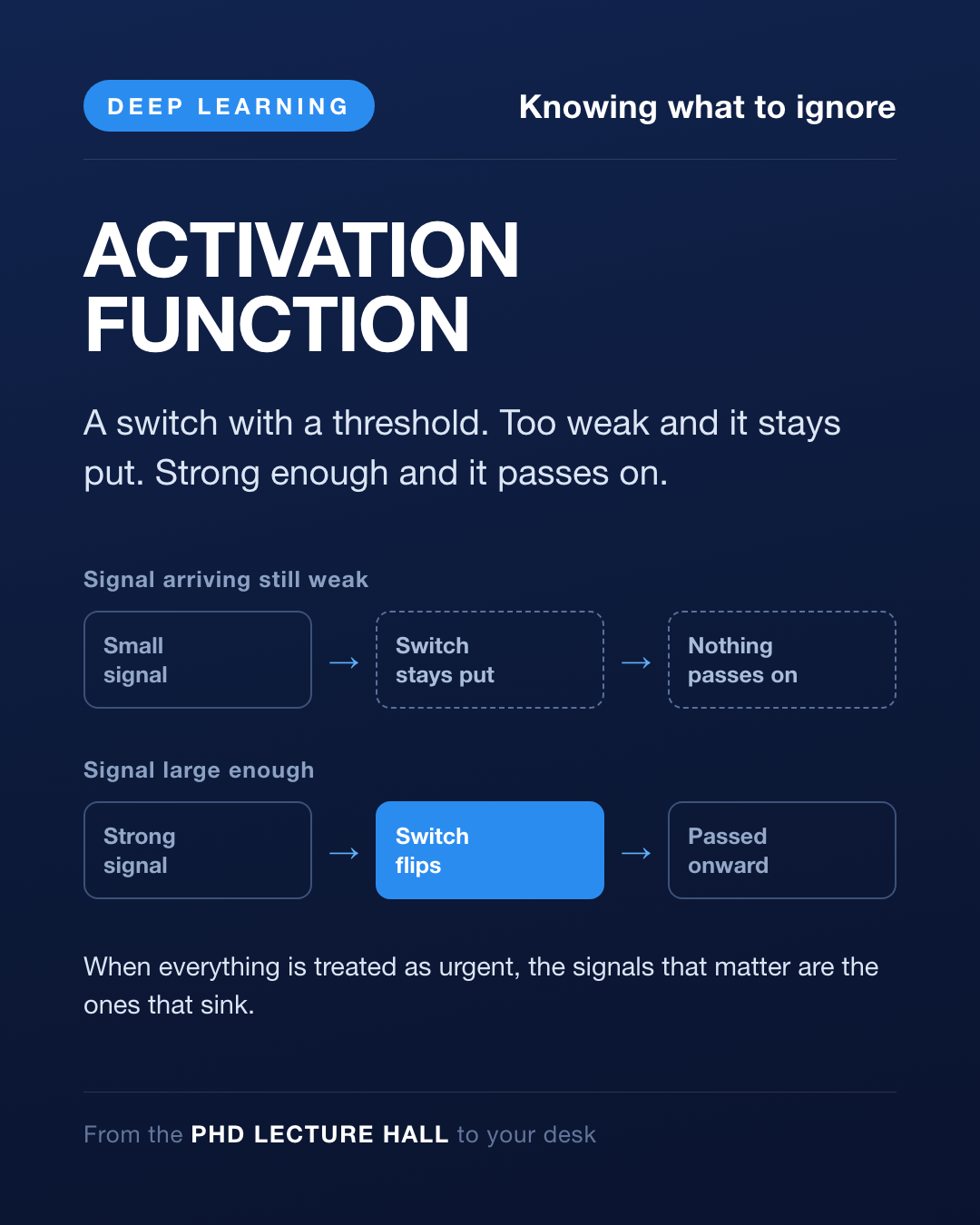
What decides whether a “cell” in a neural network should speak up or stay quiet? The answer lies in a small detail called the activation function, and it suggests a fair amount about how we make decisions.
Picture it as a switch with a threshold. A signal arrives still weak, not strong enough, and the switch stays put, treating it as not worth bothering with. Only when the signal is large enough does the switch flip and pass it on. The function most used today, called ReLU, does exactly that decisive job. It sounds small, but it is precisely this ability to select what deserves attention and what to let go that lets a model handle the complicated situations of real life. Without that selection step, however many layers you stack, the whole network is only a flat calculation and cannot learn anything subtle.
People in decision-making roles are the same. A person's value does not lie in reacting to everything that arrives, but in distinguishing what deserves action from what should be allowed to pass. An effective team is not the noisiest one; it is the one that concentrates on the signals that matter. Because when everything is treated as urgent, the signals that genuinely deserve attention are the ones that sink.
This week, which signal genuinely deserves your concentration?
To your desk
A capable person, like a good switch, knows when to flip into action and when to let a small thing pass.
Try something simple today: split the task list into two groups, important enough to start on, and able to be let go. The second group is usually longer than we think. Because focus, in the end, is a skill of selection.