The momentum you keep
Why do some models get past a hard patch easily while others get stuck halfway? Often the difference is something very familiar: momentum.
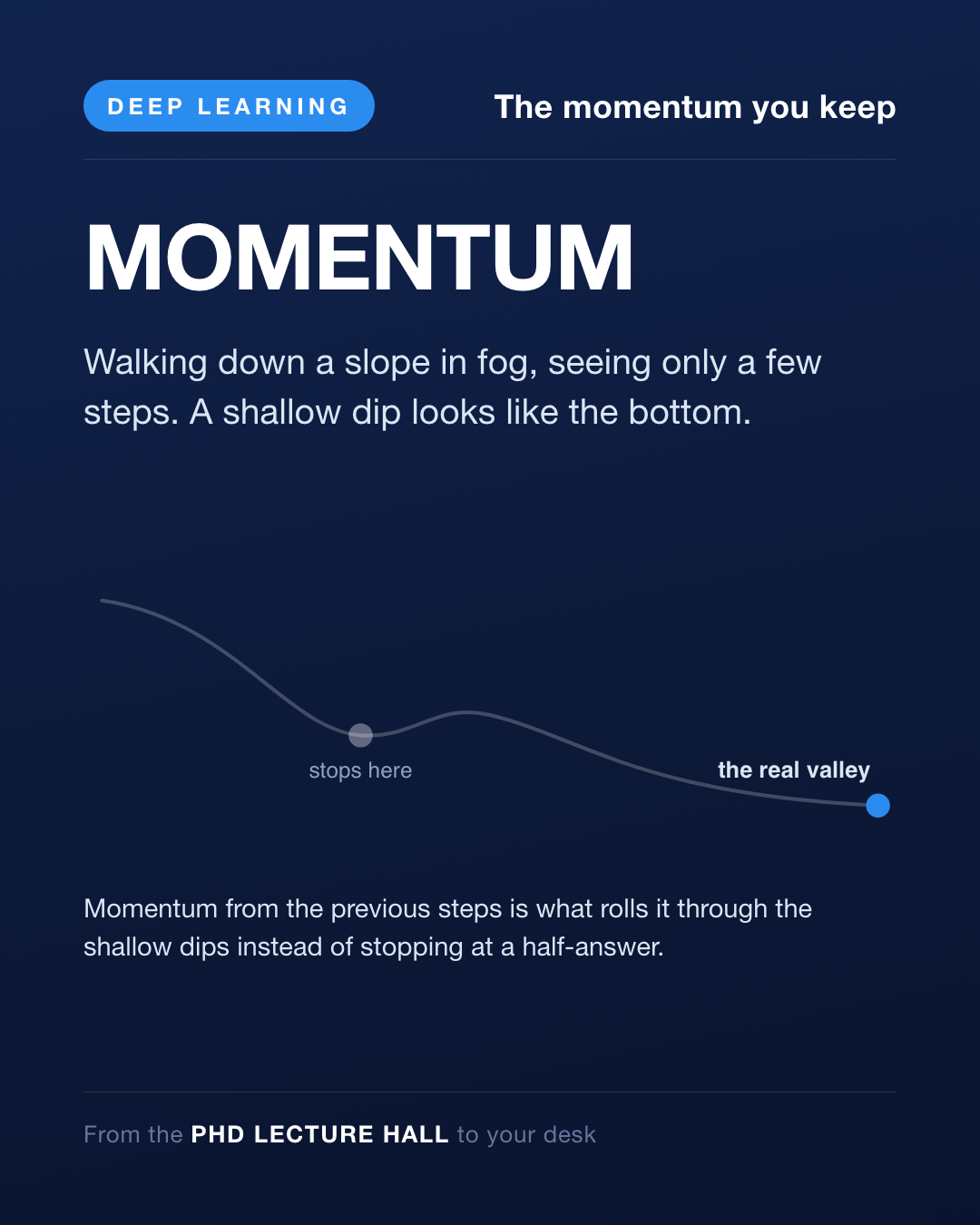
Why do some models get past a hard patch easily while others get stuck halfway? Often the difference lies in something very familiar: momentum.
Imagine someone walking down a slope in thick fog, able to see only a few steps ahead. Reaching a flat patch or a shallow dip, they easily assume they have hit the bottom and stop, when in truth the real valley is further down. Modern algorithms give a model something like the momentum of a person already walking: by keeping the push from previous steps, it rolls through the shallow dips instead of stopping too early at a half-answer.
The growth of an organisation seems to me the same. Meaningful results rarely come from one breakthrough; they come from the momentum accumulated by a great many small things done steadily. And it is precisely in the hard stretches, when everything seems to stall, that the momentum built up beforehand is what keeps us moving. Constantly stopping and starting over is the most exhausting way to work.
What are you patiently accumulating each day, and should not let break this week?
To your desk
A model gets through a bottleneck because it has momentum. So does our persistence, as long as the rhythm does not break.
Looking back over the past six days, what did you keep going steadily? Even on a busy day when you only managed the bare minimum, keeping the run unbroken is worth more than stopping entirely. Accumulated momentum is one of the most durable resources there is, and one of the easiest to lose.