Reading the trail AI leaves
This is a principle I believe holds for AI and for operations alike: what you cannot see, you cannot manage.
This is a principle I believe holds for AI and for operations alike: what you cannot see, you cannot manage.
What observability is
Picture a restaurant where every dish leaves a record: who ordered it, when it was prepped, how long it cooked, how it was checked before going out. When a customer complains, you can trace back to exactly which step went wrong. Observability in AI is the same: every step an AI system passes through, from receiving the question, to looking up documents, to composing the answer, leaves a readable trail, so it can be checked and corrected.
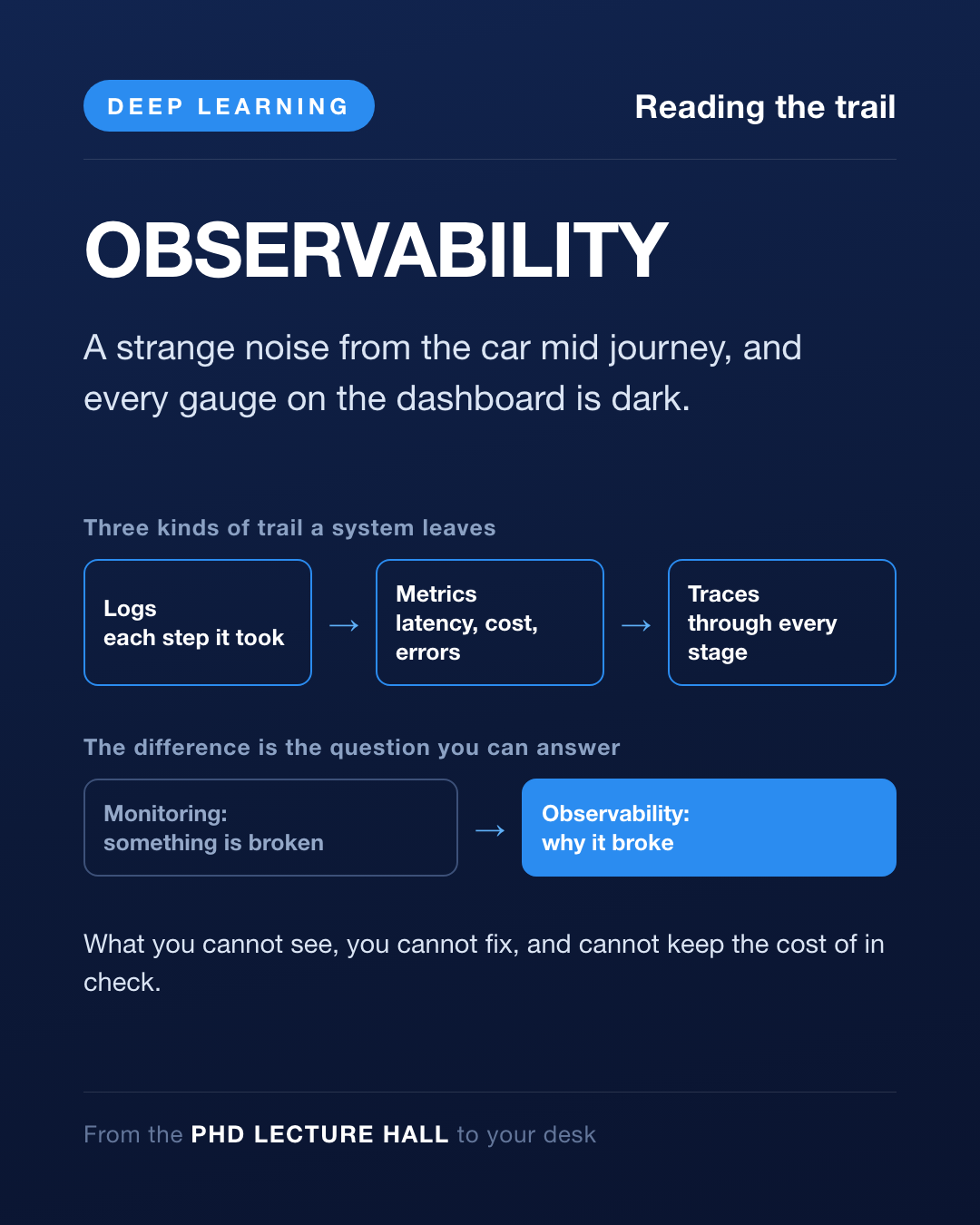
The trail usually comes in three kinds. Logs record each step it took. Metrics are the aggregate numbers such as latency, token cost and error rate. And traces follow one request through every stage. The foundation for this has become a shared standard: OpenTelemetry, merged from the OpenTracing and OpenCensus projects in 2019, graduated within the Cloud Native Computing Foundation in May 2026 and is the second largest project there, after Kubernetes.
How this applies to running a business
I see many businesses use AI as a black box: a question goes in, an answer comes out, and when it is wrong nobody knows where. Hard to fix, hard to improve, hard to trust.
The wider principle applies to every process. If something important runs without leaving a trail, then when it fails all you can do is guess. Designing in points of record, who did this step, on what basis, with what result, is how a murky process becomes one that can be learned from and corrected.
When something your AI or your team did turns out wrong, can you currently trace back to exactly which step failed?