The machine that learned to see
One of the great turns in technology was the day computers began to see. Before that, teaching a machine to recognise a cat meant describing every feature by hand.
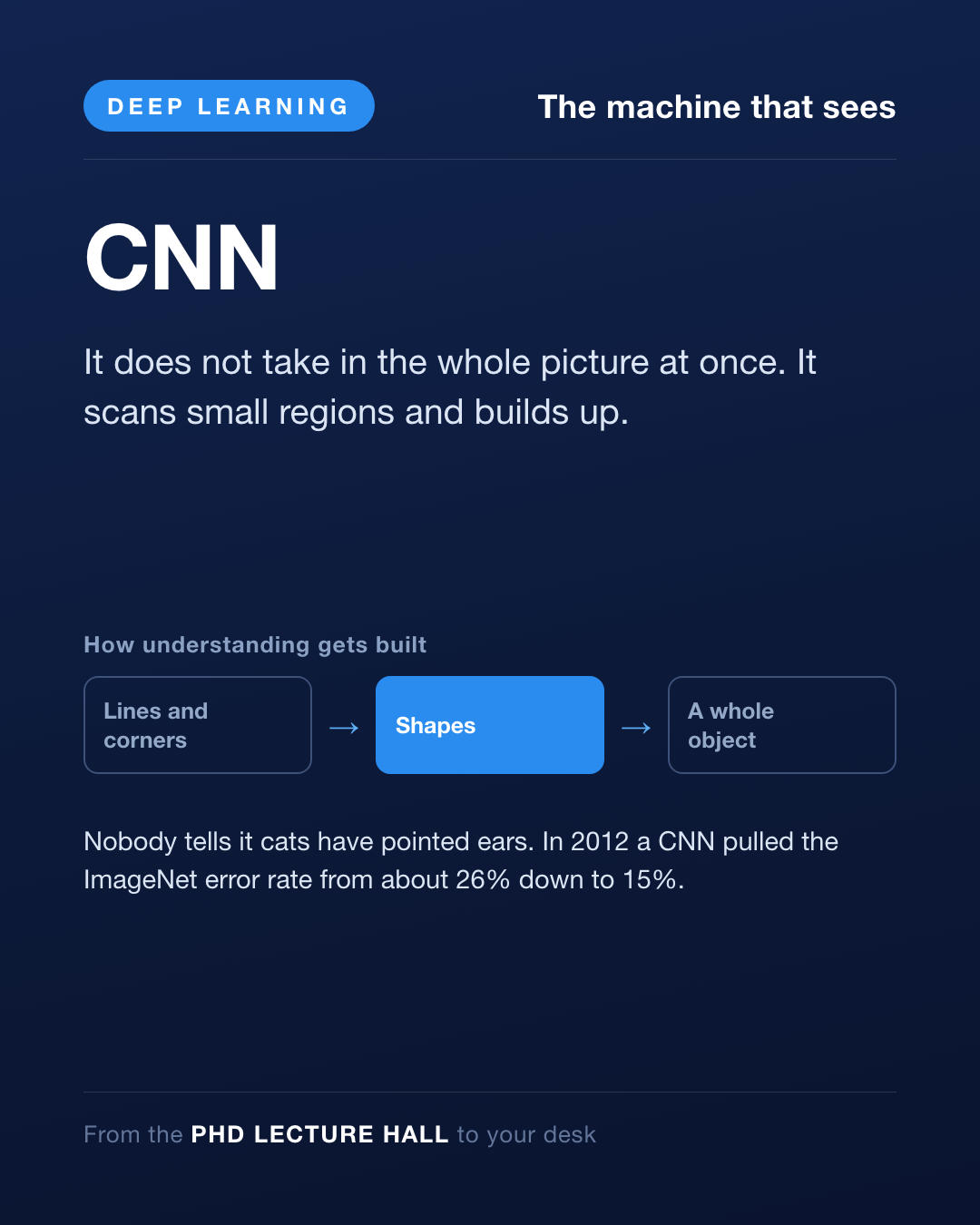
One of the great turns in technology was the day computers began to “see”. Before that, teaching a machine to recognise a cat meant painstakingly describing each feature by hand, a near-impossible task against the endless variety of real cats. Then an approach called the convolutional neural network, CNN, changed everything.
The way it “looks” is rather like the way the human eye assembles an image. Instead of examining the whole picture at once, a CNN scans small regions. The early layers recognise only simple details such as lines and corners. Later layers assemble those details into shapes, and then into complete objects. Nobody tells the machine that “cats have pointed ears”; it draws that out for itself after seeing enough pictures.
The milestone usually cited is 2012. At the ImageNet image recognition competition, around 1.2 million images across 1,000 object categories, a CNN model pulled the error rate down from about 26% to 15%, leaving every previous approach far behind. From then on, machine sight genuinely entered everyday life.
What I notice is how a CNN builds understanding: from small nearby details, gradually assembled into the large picture. Many organisations do the reverse, looking only at the aggregate number at the top and missing the small signals at the front line, where problems usually surface earliest.
Is your organisation seeing from the detail upward, or mainly from the summary report downward?
To your desk
Machine sight is now reliable enough for very concrete work. In manufacturing, many places use it to spot defects on the line, a scratch, a crooked seam, faster and more evenly than eyes that tire after a few hours.
You do not need a large investment to start thinking in this direction. This week, try looking again at a quality check that depends entirely on manual observation. Which step repeats most, and goes wrong most easily when people are tired? That is usually where a vision tool can help first, not replacing the person but taking the monotonous part off them.