The second you hesitate
This is the boundary I believe matters most for using AI that is both powerful and easy to live with.
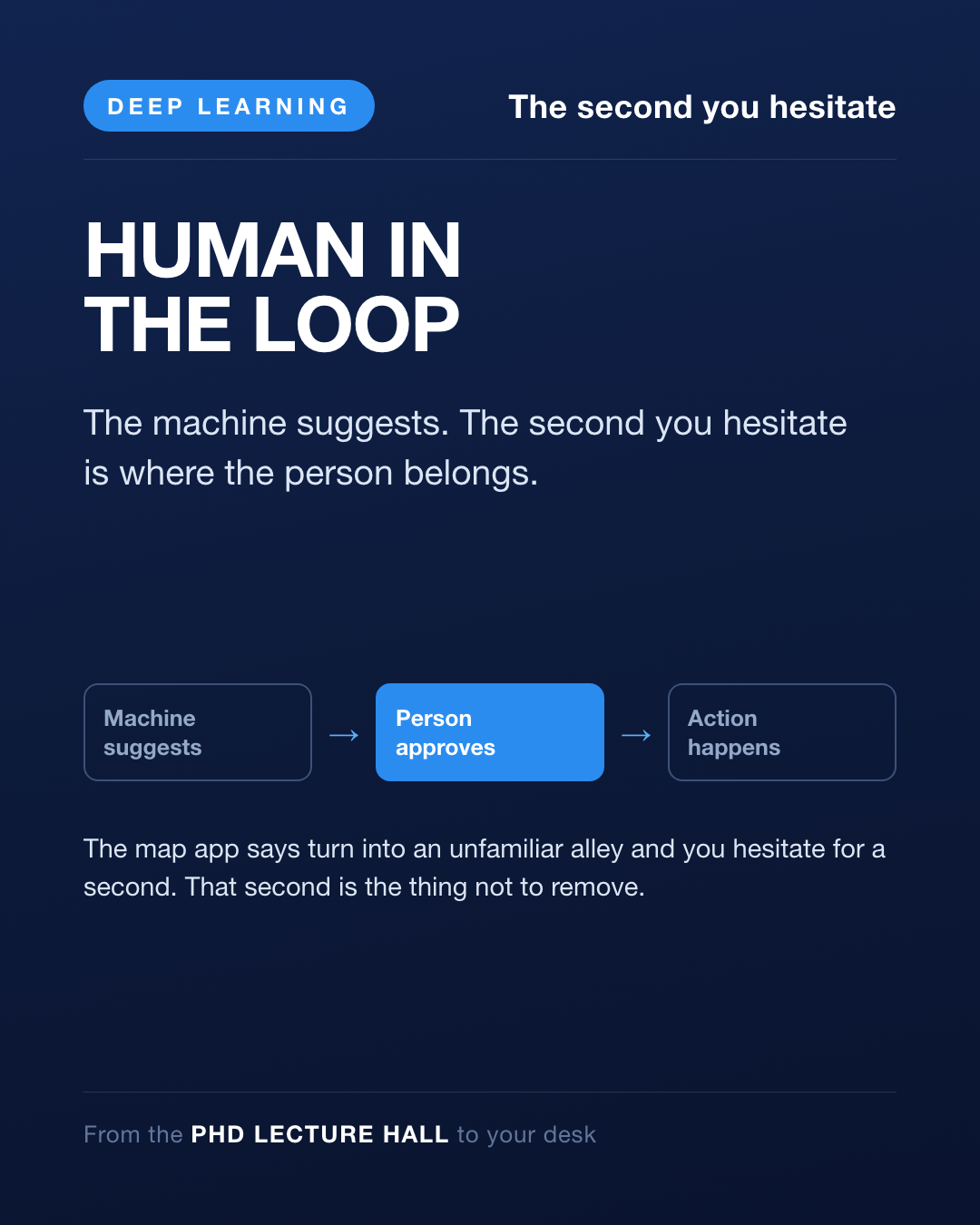
This is the boundary I believe matters most for using AI that is both powerful and easy to live with.
What human in the loop means
Picture a modern aircraft with a very capable autopilot. It flies most of the journey, but the captain is still sitting there, watching, and holds the decision at the moments that count. Human in the loop is exactly that principle: AI proposes and processes, but the final say at the important points stays with a person.
History holds one chilling illustration. In the early hours of 26 September 1983, the Soviet early warning system reported that the United States had launched missiles. The officer on duty, Lieutenant Colonel Stanislav Petrov, suspected a false alarm and decided not to pass the signal up the chain. He was right, and one person's judgement may have averted a catastrophe. Today, Article 14 of the European AI Act, in force from 2024, requires high-risk AI systems to carry human oversight.
How this applies to running a business
I find the practical question is not "should a person check" but "where should they check". Making people approve everything throws away the benefit of automation. Letting AI decide everything carries the risk. The craft lies in placing the checkpoint correctly: decisions touching money, people or reputation need a person's approval, while small and easily reversed work can run on its own.
Designing a good loop means letting AI carry the volume while people keep the judgement, exactly at the points where a mistake is hard to undo.
Among the work you currently let AI do, where would a wrong decision be hard to reverse, and has anyone put a hand on it there?