How good is good
This is the question I ask before trusting any AI tool: on what basis do we say it is good?
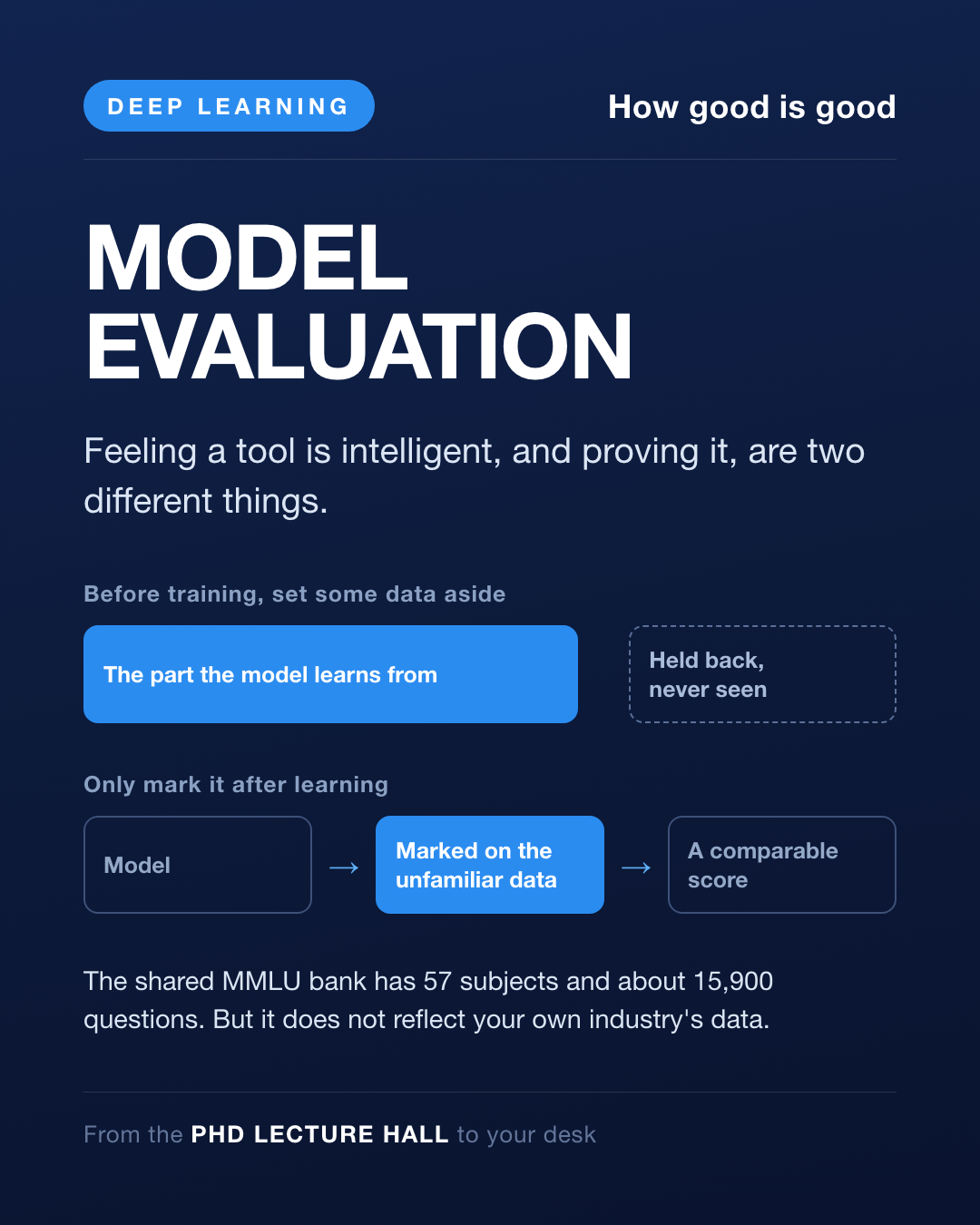
This is the question I ask before trusting any AI tool: "On what basis do we say it is good?"
What model evaluation is
Picture hiring someone. You do not choose them simply because they talk well, you give them a real test with known answers and mark it. Model evaluation does exactly that with AI: instead of trusting the feeling that an answer sounds agreeable, the model is marked against a standard set of questions with known answers, and measured as a number.
Before training, a portion of the data is set aside that the model will not see while learning, called the test set. Only after learning is it marked on that unfamiliar data. The field also builds shared question banks so every model sits the same measure. A well-known one is MMLU from Hendrycks and colleagues, introduced in 2020 and presented at the ICLR 2021 conference, covering 57 subjects from mathematics, law and medicine to history, with around 15,900 multiple-choice questions.
How this applies to running a business
I find this is the habit many businesses still lack when choosing an AI tool: deciding on the strength of a polished demonstration rather than a test on their own data. An AI assistant that sounds intelligent is quite different from one that answers correctly on a hundred real questions from your own customers.
The healthy approach is to build a small question bank of your own: a few dozen real situations with the answers you would expect. Each time you try a tool or a new version, run it through that bank and count. A decision resting on a number always holds better than one resting on a feeling.
If you had to mark the AI tool you use against a real question bank of your own, do you have that bank yet?